Rotating Injection Sites for Weekly GLP-1 Medications: a 4-Week Pattern
Lipohypertrophy is rare on weekly GLP-1 injection but not zero. Here's a simple 4-week abdomen-and-thigh rotation pattern, with the FITTER guidance behind it.
By Daisy Lin
Medical Writer • Reviewed April 25, 2026
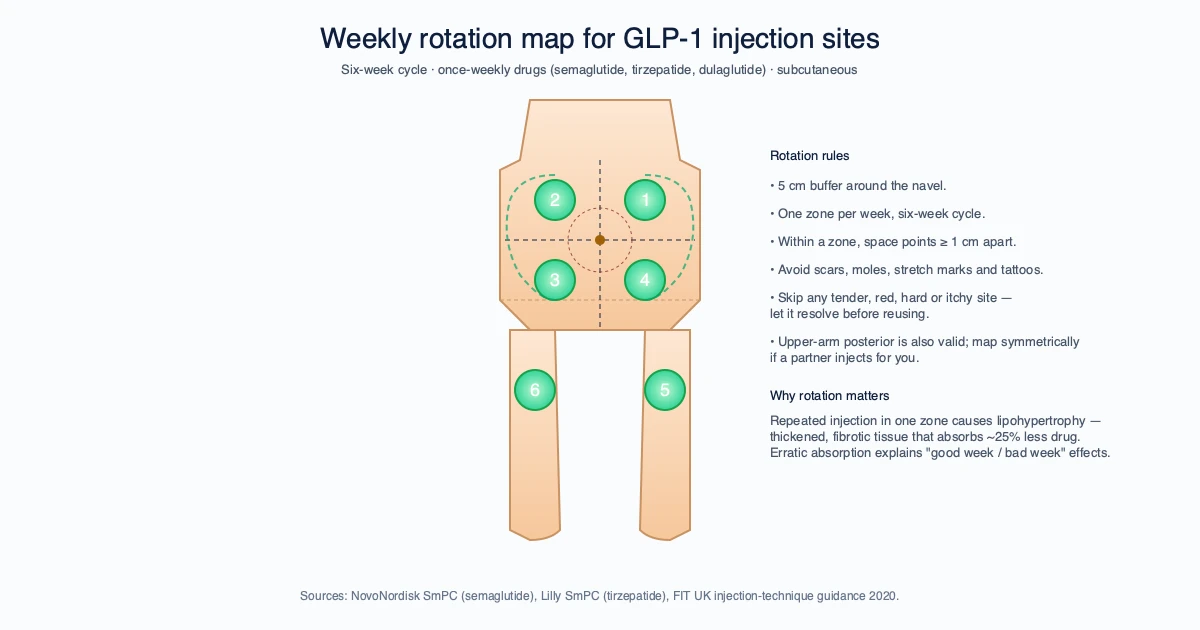
For weekly GLP-1 medications (Mounjaro, Wegovy, Ozempic), rotate across four sites on a four-week cycle: week 1 left abdomen, week 2 right abdomen, week 3 left thigh, week 4 right thigh, then repeat with each point shifted 2 cm. Within any region, keep each new injection at least 1 cm from the previous one. Lipohypertrophy is rare at weekly dosing — far less common than in daily insulin users — but it is not zero, and the prevention costs nothing.
This article covers what the actual risk looks like for Mounjaro, Wegovy, Ozempic and similar weekly subcutaneous medications, and gives a four-week rotation pattern simple enough to remember on a Sunday morning.
What lipohypertrophy actually is
Lipohypertrophy is a localised area of swollen, thickened subcutaneous tissue at a frequently injected site. To touch, it feels like a small rubbery cushion under the skin — sometimes obvious, sometimes only detectable on careful palpation. Once formed, it changes the absorption profile of subsequent injections in that area: medication injected into a lipo lump can be absorbed unpredictably, with under-dosing on some occasions and accumulation on others.
The Blanco et al. 2013 study, the largest dedicated prevalence survey, found lipohypertrophy in 64.4% of insulin-treated diabetic adults. That group was injecting up to four times daily, often with poor site rotation, sometimes with re-used needles. The risk factors that emerged from the same data were unsurprising: needle reuse, failure to rotate sites, smaller injection-site pool used repeatedly, and longer duration of insulin therapy.
For weekly subcutaneous medications like Mounjaro, Wegovy, Ozempic and Saxenda, the per-injection insult to the tissue is the same as for insulin. The frequency is much lower — roughly 52 weekly injections per year vs 1,200+ daily insulin injections per year. The cumulative tissue insult is therefore much lower.
There is no published large-scale prevalence study of lipohypertrophy in GLP-1 weekly users; the medications are too new and the user population is still too small. Anecdotal reports in the published literature and in patient communities suggest lipohypertrophy does occur on weekly injection, particularly in users who consistently inject the same patch of abdomen for months. The EMA Summaries of Product Characteristics for Mounjaro, Wegovy and Ozempic all advise rotating injection sites.
What rotation actually means
The Forum for Injection Technique UK recommendations specify two complementary practices:
- Rotation between injection regions (abdomen left, abdomen right, thigh left, thigh right), week-to-week
- Rotation within a region (different points within the chosen abdomen quadrant), across weeks within the same broader cycle
The original FITTER 2016 recommendation was that within a region, each new injection should be at least 1 cm from the previous injection site.
For a once-weekly subcutaneous medication you do not need a complicated grid. You need a rotation big enough that you do not hit the same square centimetre of tissue twice within the same season.
A 4-week rotation pattern that works
Here is the simplest version that keeps you within FITTER guidance:
| Week | Region | Site |
|---|---|---|
| 1 | Abdomen left | A point about 5–8 cm left of the navel, mid-height |
| 2 | Abdomen right | A point about 5–8 cm right of the navel, mid-height |
| 3 | Thigh left | The outer-front of the upper thigh, halfway between hip and knee |
| 4 | Thigh right | The same point on the right thigh |
Then repeat, but on the second cycle through, shift each point about 2 cm up or down from where you injected last cycle. By the time you come back to the same broad region 4 weeks later, your tissue will have had a month to recover, and on the next cycle the precise point is offset enough that you are not stacking insults.
The Mounjaro KwikPen and the Wegovy and Ozempic FlexTouch pens all permit upper arm injection too, but it is harder to self-administer cleanly and is mainly used by patients who have a partner injecting for them. The abdomen-and-thigh pattern above is sufficient for any adult self-injecting alone.
The "do I need a chart" question
A surprising number of people we hear from try to track their rotation on a sticky note that gets lost behind the kettle. We recommend printing a simple two-shape diagram, sticking it on the fridge, and putting an X with the week number every time you inject. After three months you have a record on paper that takes the cognitive load entirely off your head.
There are diabetes-targeted rotation charts widely available; most adult GLP-1 users do not need anything that elaborate, because four sites and a pen is easier to track than four sites times four daily insulin injections.
What to avoid
- Same-site repeat injection week after week, even if it is "the most comfortable" spot. Comfort is exactly the warning sign — you are picking the spot that is becoming insensate from repeated injection.
- Injection through a visible nodule, scar, or hardened patch. The drug absorption from these tissues is unpredictable.
- Injection within 5 cm of the navel. Skin tension and fat distribution near the umbilicus is uneven; the FITTER recommendations specifically advise against this zone.
- Re-using pen needles. A single-use pen needle is single-use. After one injection, the bevel is microscopically blunted, the silicone lubrication is partially stripped, and the needle becomes more painful and more tissue-traumatic on subsequent uses. This is the single biggest avoidable risk factor for lipohypertrophy in the published evidence — more important than rotation itself. The InjectKit 31G × 4 mm pen needle 100-pack covers nearly two years at weekly cadence.
What to do if you find a lump
A small, soft, tender area for a day or two after injection is normal — it is the bruising and the tissue response to the injection itself, not lipohypertrophy. It resolves.
A persistent firm, rubbery lump that is still palpable a week later, sits exactly under recent injection sites, and does not hurt to touch is suggestive of early lipohypertrophy. The standard advice is to stop injecting in that area for at least three months, rotate to other regions, and let the tissue recover. The Blanco et al. follow-up data shows that affected tissue typically resolves over 4 to 6 months without any active treatment, given the injections stop.
If a lump is hot, red, spreading, painful or accompanied by fever, that is not lipohypertrophy — that is a possible injection-site infection, and you should call your prescriber.
FAQ
How often do GLP-1 users get lipohypertrophy? There is no large-scale prevalence study yet. Anecdotal evidence suggests it is much rarer than the 64.4% rate seen in daily-insulin users, but not zero — particularly in patients who inject the same patch of abdomen for months.
Can I always inject in the abdomen? You can, but you should rotate between regions and within the abdomen itself. Same-region-only injection accelerates lipohypertrophy.
Should I rotate within the same week or only week to week? Weekly GLP-1 medications only need week-to-week rotation. Daily insulin users need within-week rotation as well.
Is the upper arm a good site for Mounjaro? The SmPCs permit it, but it is hard to self-administer cleanly. Most self-injectors stick to abdomen and thigh.
What if I forget where I injected last week? Print a simple two-shape diagram and mark each injection with the date. Three months in, you have a real record without relying on memory.
The honest summary
Lipohypertrophy at weekly dosing is uncommon. We do not have prevalence numbers for GLP-1 weekly users yet — the drugs are too new. We do have decades of insulin data showing that the prevention is the same in either case: rotate sites, do not re-use needles, do not inject through existing damaged tissue.
Thirty seconds a week marking an X on a fridge chart is not a heavy ask in exchange for keeping the absorption of an expensive, time-consuming weekly injection predictable. If you are stocking up, the 31G × 4 mm pen needle range covers the supply side, and our starter kit bundles needles, alcohol pads and a 0.5 L home sharps bin.
Sources
- Frid AH, Kreugel G, Grassi G, et al. New Insulin Delivery Recommendations (FITTER). Mayo Clin Proc. 2016;91(9):1231–1255 — doi.org
- Blanco M et al. Lipohypertrophy in Insulin-Treated Diabetes: Prevalence and Associated Risk Factors. Diabetes Metab. 2013;39(5):445–453 — doi.org
- European Medicines Agency, Mounjaro EPAR — ema.europa.eu
- European Medicines Agency, Wegovy EPAR — ema.europa.eu
- European Medicines Agency, Ozempic EPAR — ema.europa.eu
- Forum for Injection Technique UK Recommendations, 5th Edition — fit4diabetes.com
This article is for general information only and is not medical advice. Always consult your prescriber or pharmacist for guidance specific to your situation.
Frequently asked questions
How often do GLP-1 users get lipohypertrophy? +
There is no large-scale prevalence study yet. Anecdotal evidence suggests it is much rarer than the 64.4% rate seen in daily-insulin users, but not zero — particularly in patients who inject the same patch of abdomen for months.
Can I always inject in the abdomen? +
You can, but you should rotate between regions and within the abdomen itself. Same-region-only injection accelerates lipohypertrophy.
Should I rotate within the same week or only week to week? +
Weekly GLP-1 medications only need week-to-week rotation. Daily insulin users need within-week rotation as well.
Is the upper arm a good site for Mounjaro? +
The SmPCs permit it, but it is hard to self-administer cleanly. Most self-injectors stick to abdomen and thigh.
What if I forget where I injected last week? +
Print a simple two-shape diagram and mark each injection with the date. Three months in, you have a real record without relying on memory.
Related reading
4 mm vs 5 mm vs 6 mm Pen Needles for GLP-1 Injections: What the Evidence Says
4 mm is the modern default for GLP-1 self-injection. 5 mm is fine. 6 mm and 8 mm are mostly leftover diabetes-era stock. Here's what the FITTER consensus and EMA labels actually say.
GLP-1 Needle and Syringe Sizing Guide: Mounjaro, Ozempic, Wegovy and Compounded Vials
Mounjaro, Wegovy and Ozempic needle and syringe sizes — practical UK guidance on gauge, length and travel kit options for GLP-1 self-injection.
How to Inject Mounjaro: an 8-Step Protocol from the KwikPen Instructions
Step-by-step Mounjaro KwikPen injection protocol from the Eli Lilly user manual, with the bits where first-time UK users actually get stuck.
Get your supplies
CE-marked syringes and alcohol prep pads. Shipped from Spain across the EU and UK.