Subcutaneous Injection Sites: Abdomen, Thigh, Upper Arm Explained
The three subcutaneous injection sites — abdomen, outer thigh, upper arm — compared on absorption speed, comfort, ease of self-injection, and lipohypertrophy risk. NHS-aligned UK guide.
Founder & Compliance Lead • Reviewed May 20, 2026
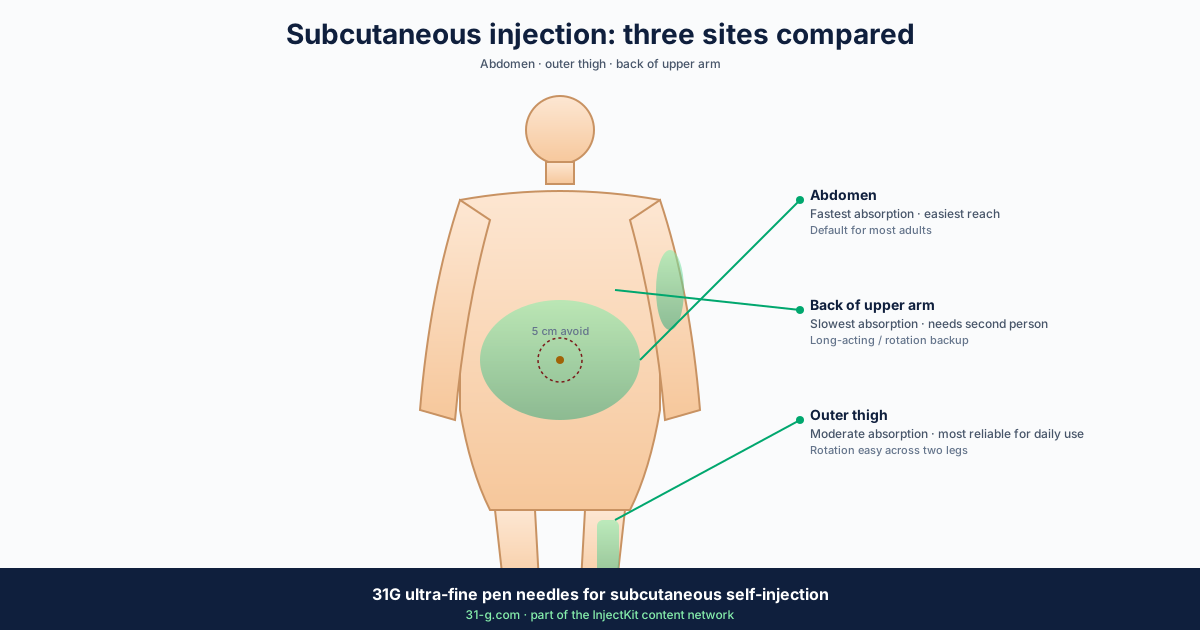
Subcutaneous self-injection has three accepted sites in adults: the abdomen (around the navel, but not the navel itself), the outer thigh, and the back of the upper arm. The abdomen absorbs fastest and is the easiest site to reach one-handed; the outer thigh is the most reliable for daily use because rotation is straightforward; the upper arm absorbs slightly slower and is awkward to self-inject. Pick the abdomen by default, rotate within it across days, and add the thighs once you've practised the pinch-lift on a forgiving surface.
Who this guide is for
You self-administer a subcutaneous medication — GLP-1 weekly, insulin, vitamin B12, allergy desensitisation, or a similar protocol — and you want a clear picture of which body site to use, when. NHS injection-technique guidance covers the broad strokes but rarely names the trade-offs that matter once you're doing this two or three times a week. This guide is the practical decision tree, with the absorption physiology, the rotation pattern, and the things that go wrong when you change sites under pressure.
The three sites apply to subcutaneous (subq, SC) injection — the layer of fat between skin and muscle. Intramuscular injection uses different sites and is covered separately on the 29-G blog under intramuscular injection technique.
The three subcutaneous injection sites
Abdomen
The standard adult subq site is the abdomen, with a 5 cm exclusion zone around the navel. The pinch-up region runs from just below the ribs to the top of the pubic bone and laterally to about the mid-axillary line — roughly the front-facing area of a t-shirt, excluding the central strip.
Why the abdomen wins by default:
- Easiest to see and reach. No twisting, no mirrors, no contorted angles. You can self-inject seated.
- Largest available area. Even with the navel exclusion, you have ~12 zones to rotate through.
- Most consistent absorption in most adults. Subcutaneous fat thickness is reasonably stable across the abdominal area in non-lean adults.
- Pinch-lift is reliable because abdominal skin is loose enough to lift cleanly without dragging muscle.
Where the abdomen has trade-offs:
- Bloat after large meals or in the second half of the day changes the skin fold height — what was a clean 2 cm pinch in the morning is a flat 5 mm fold by 7 PM. Inject before meals if possible.
- Lean adults sometimes don't have enough subcutaneous fat at the upper abdomen — in that case, drop lower (just above the inguinal crease) where the fold is thicker.
- Tattoos and scars in the rotation zone become tempting "landmarks" that you accidentally inject through repeatedly. Avoid both.
Outer thigh
The outer thigh runs from a hand's-width above the knee to a hand's-width below the hip, along the front-outer surface. The vastus lateralis muscle sits underneath, but for subq you stay in the fat layer above it.
Use the thigh when:
- The abdomen needs rest (lipohypertrophy concerns, recent injection-site irritation).
- You're injecting in public or somewhere you can't lift a shirt.
- You're using a 4 mm pen needle and confident in the pinch-lift technique — thigh subq fat is sometimes thinner than abdomen, so the depth margin is smaller.
The classic thigh mistake is going too close to the knee, where the fat layer thins out and you end up injecting muscle. Stay above the mid-thigh line.
Back of the upper arm
The back of the upper arm — the triceps area, roughly between the shoulder and the elbow — is the third option. It absorbs slightly slower than the abdomen (about 70-80% of abdominal rate in most studies) and is the hardest site to self-inject because you need to pinch the fold with one hand and inject with the other on the same side, or use a mirror and your dominant hand on the opposite arm.
Reserve the upper arm for:
- A second adult administering the injection (carer, partner). One-handed.
- Long-acting insulins where slower absorption is acceptable or desired.
- Rotation backup when abdomen and thighs both need rest.
Choosing between the three sites
Most adults end up with this pattern after a few weeks of self-injecting:
| Frequency | Default site | Rotation rule |
|---|---|---|
| Daily (e.g. insulin) | Abdomen, 8-zone grid | Move 2 cm each injection within a zone, full zone rotation across the week |
| Weekly (e.g. GLP-1) | Abdomen one week, alternating thigh the next | Different quadrant + different site monthly |
| Once-monthly (e.g. some vitamin B12 schedules) | Either thigh | Alternate left/right |
| Twice-weekly (e.g. some allergy schedules) | Abdomen + one thigh | Mark the calendar |
The 2 cm rule between adjacent injections is the practical floor; some sources say 1 cm, others say 2.5 cm. The point is not the precise number but that you don't stack injections within the same square centimetre of skin, which is how lipohypertrophy starts.
Step-by-step technique per site
The mechanics are identical across all three sites; only the geometry changes.
- Wash hands. Soap and water for 20 seconds. Hand sanitiser only if soap isn't available.
- Choose the spot. New location at least 2 cm from your last injection. No bruises, no scars, no inflamed skin.
- Clean the skin (optional for clean home use). A 70% isopropyl alcohol swab over the site. Let it dry completely — injecting through wet alcohol stings and is also irritating to the subcutaneous tissue. Drying takes 15-20 seconds, longer than you think.
- Pinch a fold of skin and subcutaneous fat between thumb and forefinger. Pinch wide enough that you're lifting a 2-3 cm fold; deep enough that you can feel the fat layer separated from underlying muscle.
- Insert the needle at 90° for most adults with a 4 mm or 6 mm pen needle, or at 45° for very lean adults or longer needles. The needle hub should reach the skin; that's how you know the needle is fully in.
- Inject slowly. A standard insulin syringe (1 mL or less) takes 5-8 seconds to deliver. A weekly GLP-1 takes whatever the device dispenses at. Faster injection hurts more and bruises more.
- Count to 10 with the needle still in (5 seconds is the minimum). This prevents medication leakage back up the needle track.
- Withdraw straight out at the same angle you went in. Release the pinch.
- Don't massage the site. Subcutaneous medications are designed to absorb at a controlled rate from the depot you've just created. Massaging accelerates absorption unpredictably.
- Dispose of the needle into a sharps bin. Never recap a used needle. UK households can request a yellow-lid sharps bin via their GP or buy one directly; private GLP-1 users typically get one from the clinic. Full sharps bin guidance is in sharps disposal at home.
Site rotation: why it matters
Repeated injection into the same subcutaneous spot causes lipohypertrophy — a soft, fatty lump under the skin that develops over weeks of stacked injections. The lumps absorb medication erratically: sometimes slower than fresh skin (causing high glucose for insulin users, or attenuated effect for GLP-1), sometimes faster (causing hypoglycaemia or amplified side effects). Once a lipohypertrophy has formed, it can take six months to a year of rest before injecting into that spot again is safe.
The rotation rule is therefore simple: don't inject into the same square inch twice in a row. If you're using the abdomen as your default site, divide it into 8 to 12 zones (think of a 3×4 grid around the navel) and use a different zone each injection. Within a zone, move 2 cm each time. After two weeks, the first zone has had enough rest to be back in the rotation.
Some users find it easier to assign zones to days of the week — Monday upper-right, Tuesday upper-left, etc. — and only inject within the assigned zone for that day. Either approach works; what matters is that the rotation is systematic, not improvised.
For users on multiple daily injections, the same zone-rotation logic applies but accelerated: the within-zone 2 cm shift becomes critical because you'll cycle through every zone in a single day.
What can go wrong (and how to spot it)
The needle hits muscle instead of subcutaneous fat.
You'll feel it as a deep, dull ache during injection that doesn't ease off — different from the sharp surface sting of a too-quick subq. Most common in lean adults using a 6 mm needle on the thigh without pinch-lift, or anywhere on the body if you go in at 90° without pinching. The fix: pinch-lift firmly next time, consider a 4 mm needle if you're lean.
Bruising 24-48 hours later.
A small purple-yellow patch at the site is normal occasionally and means you nicked a small subcutaneous capillary. Frequent bruising means either the needle is going in too fast (slow down), the site has been overused (rotate further), or you're on a blood thinner that increases the risk (talk to the prescriber). Ice the site for 10 minutes if the bruise feels tender.
A welt or bump appears within minutes.
This is the medication itself creating a temporary subcutaneous depot. Most of these flatten within an hour. If a bump is still raised at 24 hours, hot to the touch, or red and growing, treat it as a possible injection-site reaction or infection and contact the prescriber or NHS 111.
Stinging during injection that goes away when you withdraw.
Usually a sign the alcohol wasn't fully dry, or the medication is at refrigerator temperature. Let pre-filled pens warm to room temperature for 30 minutes before injection — cold injections sting and bruise more for chemical reasons (cold solutions are more viscous and irritate the tissue more).
The needle bends or breaks off.
Rare but real. Bent needles happen when the pinch isn't deep enough and the needle hits underlying muscle and deflects. Never reuse a bent needle. If a tip breaks off inside the skin, mark the spot with a pen and seek medical attention — broken-off pieces can migrate.
FAQ
Which site has the fastest absorption?
The abdomen. Subcutaneous fat at the abdominal site absorbs roughly 50% faster than the upper arm and 30% faster than the outer thigh in most adult studies. For long-acting insulins this matters less; for fast-acting subq medications or for rescue use, abdomen is the practical choice.
Can I inject directly into the navel?
No. The 5 cm exclusion zone around the umbilicus avoids the navel itself (no subcutaneous fat to inject into) and the surrounding skin where the subcutaneous fat geometry is irregular. Stay outside the exclusion circle.
Do I need to pinch the skin for a 4 mm pen needle?
Most adults don't strictly need to pinch for a 4 mm pen needle on the abdomen — the needle is short enough that hitting muscle is unlikely. Pinch anyway as a habit; it forces you to think about depth and keeps the technique consistent when you switch to a longer needle.
Does it matter what time of day I inject?
For most subq medications, no — convenience and consistency matter more than the exact hour. The exception is some long-acting insulins where the clinic prescribes a specific time-of-day. Otherwise, the same time each day is the goal; the same hour exactly is not.
Can I use the upper arm if I have lipohypertrophy on the abdomen?
Yes, and it's exactly what the upper arm is reserved for in most rotation plans. Rest the abdominal site for at least three months; longer if the lumps are large or numerous. Consult the prescriber if lipohypertrophy is affecting absorption.
What needle gauge is best for subq?
For most subq self-injection, 30G or 31G insulin syringes (or 4 mm 32G/31G pen needles) are the practical choice — fine enough to minimise pain, robust enough to handle pen-needle and syringe scenarios reliably. See the needle gauge guide for the full comparison.
Related reading
- 29G, 30G, 31G: How to Actually Pick a Needle Gauge — gauge-selection deep dive
- How to Inject Properly — step-by-step subq technique
- Lipohypertrophy: Spot, Treat, Prevent — the rotation-rationale companion piece
- Sharps Disposal at Home: UK & EU Guide — what to do with the used needles
For the supplies: 31G insulin syringes at InjectKit ship from Spain to the UK and EU, in 10/30/50/100 packs.
Citations
- NHS, "How to inject insulin" — nhs.uk
- BNF, "Subcutaneous injection technique" — bnf.org
- CDC, "Safe injection practices" — cdc.gov
- Frid AH et al., "New insulin delivery recommendations" (Forum for Injection Technique consensus, Mayo Clinic Proceedings 2016) — site rotation + needle length evidence
- WHO, "Best practices for injection safety" — who.int
Frequently asked questions
Which site has the fastest absorption? +
The abdomen. Subcutaneous fat at the abdominal site absorbs roughly 50% faster than the upper arm and 30% faster than the outer thigh in most adult studies. For long-acting insulins this matters less; for fast-acting subq medications or for rescue use, abdomen is the practical choice.
Can I inject directly into the navel? +
No. The 5 cm exclusion zone around the umbilicus avoids the navel itself (no subcutaneous fat to inject into) and the surrounding skin where the subcutaneous fat geometry is irregular. Stay outside the exclusion circle.
Do I need to pinch the skin for a 4 mm pen needle? +
Most adults don't strictly need to pinch for a 4 mm pen needle on the abdomen — the needle is short enough that hitting muscle is unlikely. Pinch anyway as a habit; it forces you to think about depth and keeps the technique consistent when you switch to a longer needle.
Does it matter what time of day I inject? +
For most subq medications, no — convenience and consistency matter more than the exact hour. The exception is some long-acting insulins where the clinic prescribes a specific time-of-day. Otherwise, the same time each day is the goal; the same hour exactly is not.
Can I use the upper arm if I have lipohypertrophy on the abdomen? +
Yes, and it's exactly what the upper arm is reserved for in most rotation plans. Rest the abdominal site for at least three months; longer if the lumps are large or numerous. Consult the prescriber if lipohypertrophy is affecting absorption.
What needle gauge is best for subq? +
For most subq self-injection, 30G or 31G insulin syringes (or 4 mm 32G/31G pen needles) are the practical choice — fine enough to minimise pain, robust enough to handle pen-needle and syringe scenarios reliably. See the needle gauge guide for the full comparison.
Related reading
Get your supplies
CE-marked syringes and alcohol prep pads. Shipped from Spain across the EU and UK.